Escape rooms have grown up. What started as a locked door and a stopwatch is now immersive theater: actors, story worlds, lighting rigs, and crews who stay in character for an hour at a time. The people working those rooms need clothing that does three jobs at once — establishes a role, carries small props, and holds up through six or eight shows a day.
Why do escape rooms use custom tactical vests instead of costumes?
An escape room vest is a printed utility layer that reads as a character while staying cool enough to run 6 games a night. MarkYourVibe makes each vest to order with a design preview before ordering, so a 3 to 6 person crew can dress every room without a costume budget.
- A vest beats a full costume on a 6-game night: it goes on in seconds and does not need a changing room between rooms.
- Role markings — game master, actor, reset crew — should be readable in low light, so light lettering on a dark shell.
- Structured pockets hold reset tools and small props without breaking character.
- The order quantity is confirmed at checkout, so a small venue can build 1 character before committing to a full set.
In an escape room the vest is costume and tool kit at once: it has to read as character in the dark and still hold the reset key.
Last updated: November 22, 2026 · By the MarkYourVibe team
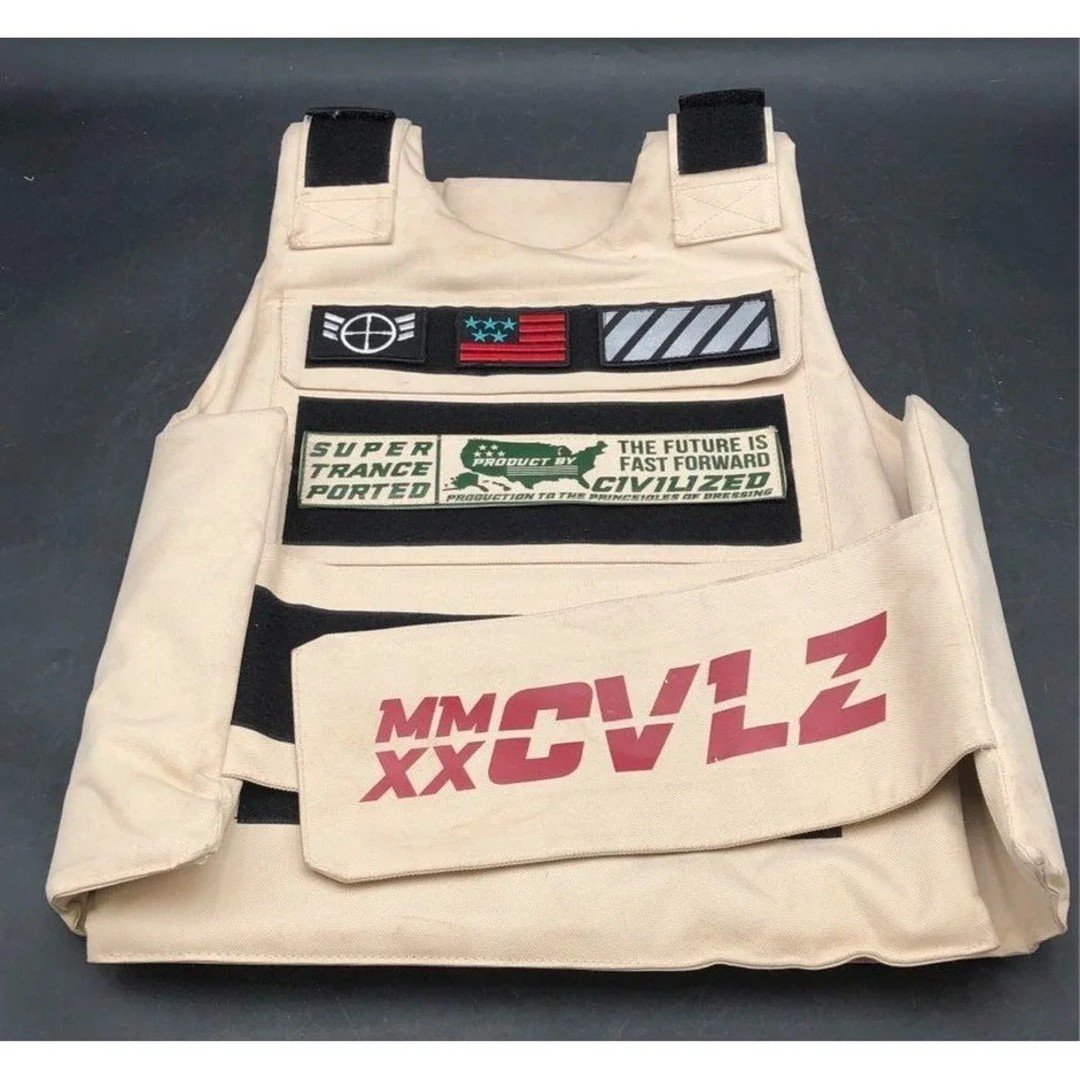
A tactical vest does all three. The vest pictured here is a good example of the approach: a light shell, a cluster of story-rich patches, contrast bands, and one bold piece of lettering that reads across a dim room. None of it needs to be military. The structure is what matters.
Why a Vest Beats a Full Costume
A costume tells guests who you are, but it often fails everywhere else. It gets hot under stage lights, it has nowhere to put a keycard or a folded clue, and it is usually too delicate to wear three times a week.
A vest sits over your own clothes, so you control layers as the room warms up. It leaves your arms free to reset a puzzle, hand over a prop, or guide a nervous group down a corridor. It also reads instantly in low light: the silhouette is recognizable even before anyone can make out the text on a patch.
For venues, there is a practical bonus. A vest is one standardized piece. You can size it to the person, keep the graphics consistent, and swap the person behind the role without rebuilding the character.
Build the Character First, Then the Graphics
Before choosing colors or patches, write down who the wearer is in one sentence. “Facility security officer.” “Field researcher who found the map.” “Courier carrying the final code.” That sentence decides everything else.
The vest in the photo is interesting because its patches feel like a biography. A reticle mark suggests observation. A striped flag patch and hazard bars suggest a uniform from somewhere specific. A slogan across the chest gives the character an attitude. Each element is small on its own, but together they imply a world.
Do the same for your crew. Give each role two or three visual clues, not ten. A role label, one emblem, and a consistent color band are enough for guests to understand the hierarchy without reading a paragraph.
Mark Roles So Guests Read Them Instantly
In an immersive setting, confusion breaks the story. If a guest cannot tell the game master from another player, the whole scene stalls. Make role identification part of the design rather than something you explain at the door.
- Color-code the crew: one shell color for game masters, another for actors, a third for technical staff who should stay invisible.
- Put the role where eyes land: a short word on the upper chest works better than a long title spread across the back.
- Use numbers for ensembles: a cast of six “agents” reads as a unit when each vest carries a number in the same font and position.
- Keep the guest-facing side simple: the front of the vest should answer “who is this?” in under two seconds.
Our guide to names, numbers, and personal details goes deeper on sizing and placement if your concept depends on identifiers.
Carry the Props That Make the Puzzle Work
Immersive crews are moving parts: keycards, sealed envelopes, small tools, radios, tokens, and spare batteries. A vest with panel space turns those objects into part of the performance instead of things you dig out of a pocket mid-scene.
Plan the load before you print the graphics. Put frequently used items where the hand naturally goes, and keep them off the same panel as a large patch or printed lettering. Heavy objects belong low and close to the body; a radio clipped high on a strap will pull the vest sideways by the end of a shift.
Also think about snagging. Loose webbing can catch on door frames, scenery, or a guest’s bag. Choose a layout with flat panels where the actor has to squeeze through tight sets, and reserve hanging attachments for roles that stay in open spaces.
Low-Light Legibility and Photo Moments
Most escape rooms are deliberately dim, and almost every guest wants a photo afterward. A design that only works under office lighting will disappear in both situations.
Use contrast aggressively. Light lettering on a dark panel, or dark lettering on a light shell, survives low light and camera flash. Avoid mid-tone combinations that look stylish on a screen and vanish at fifteen feet. Reflective or bright accent elements can mark a role without turning the vest into a safety jacket.
If the room uses colored lighting, test the palette under that light rather than in daylight. Red and green graphics can collapse into the same dark shape under a blue wash. The photo zone is worth planning for too: a clean back panel gives guests an obvious place to gather for the group shot.
Outfitting a Crew Without Losing the Thread
Group orders are where immersive concepts usually fall apart. Six vests ordered at different times, in different fits, with slightly different artwork, stop looking like a crew.
Collect every name, role, and size in one sheet before production. Lock the artwork as a set: same patch positions, same typeface, same color values. Then check the mockup of each role side by side, not one at a time. A layout that looks fine alone can clash when the whole cast stands together.
Plan for turnover as well. Cast changes happen, and a vest that fits one actor may not fit the replacement. Order a spare in the two most common sizes and keep the role markings modular so a new person can step into the story quickly. Our notes on patch layout and placement are useful when you need a design that can be re-assigned rather than rebuilt.
Bring Your Crew to Life at MARKYOURVIBE
The best immersive costume is the one nobody notices as clothing — guests just believe the character. Start with the role, build the graphics around it, and make sure the vest can carry a real shift.
Your gear, your rules. Design your custom tactical vest at MARKYOURVIBE and get your whole crew ready for the next door you open.
Custom tactical vests for escape room crews at a glance
| Made to order | Yes |
|---|---|
| Order process | Review the design preview before ordering |
| Role markings | Game master, actor, reset crew |
| Low-light note | Light lettering on a dark shell reads best |
| Typical crew | 3-6 staff per venue |
| Shipping | Destinations are listed in the Shipping Policy |
Frequently asked questions
Why do escape rooms use custom tactical vests instead of costumes?
Because a vest reads as character, goes on in seconds and stays cool through 6 games a night, while a full costume needs a changing room between rooms. MarkYourVibe makes each vest to order with a design preview before ordering, so small venues can outfit 3 to 6 staff.
How do you mark staff roles without breaking the theme?
Use 1 detail per role — a color block, a patch or a short wordmark — so guests read who to ask without the vest looking like a name tag. Keep it readable in low light. MarkYourVibe prints role markings to order with a design preview before ordering.
What should a game master carry on the vest?
Reset tools, a small prop, a phone and a pen — 4 items that otherwise end up in a pocket or on a shelf mid-game. Structured pockets keep them silent and out of sight. MarkYourVibe makes each vest to order. Shipping destinations are listed in the Shipping Policy.
Will lettering be readable in a dark room?
Light lettering on a dark shell reads best under low light and UV, and it also photographs well for the post-game photo. Avoid dark-on-dark combinations. MarkYourVibe prints the layout to order with a design preview before ordering.
Can a small venue order one character at a time?
Yes. The order quantity is confirmed at checkout, so a venue can build 1 character, test it in a live room and add the rest of the crew later. MarkYourVibe prints each order to order. Shipping destinations are listed in the Shipping Policy.